Caring together
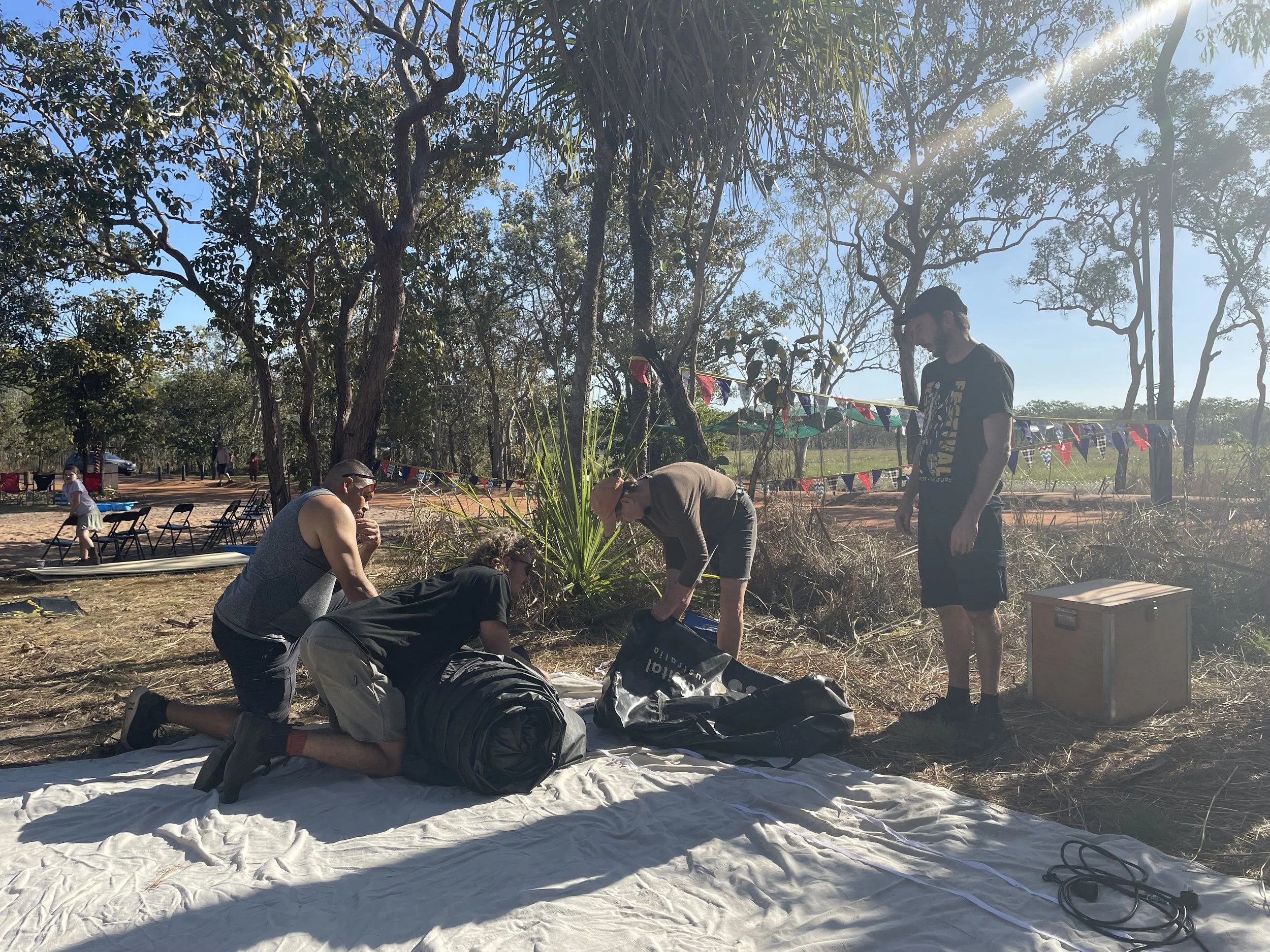
NTTFF equipment training for new staff at Daminmin Festival
How do we learn together?
Michaela talked of a colleague talking about togetherness. “That feeling that we had together.” (Michaela - please feel free to correct this and also can you remind me of your colleagues name)
Often I am confronted with conversations that sit at deep odds with my thinking particularly when it comes to my purpose.
Screen Territory questioned why I would run NTTFF if I was not making a profit or a times even taking a wage.
A colleague who I respect apologised to me for my small business not getting funding for youth outreach, thinking my disappoint was due to money not being in my pocket rather than my concern for young people who walk the streets at night.
A project I am consultant on keeps pushing the corporate and government stakeholders timelines and expectations, rather than listening to my feedback on the Indigenous artists timelines and expectations.
A past employer took my questions of funding secured for youth projects being repurposed for admin and rent as a personal affront.
How do you cultivate a space of (re)learning of care, of community tenderness, of collective responsibility?
Our western ontology focuses around the individual, that sits within their own container. Our senses of values and ethics stems from this and anything that sits beyond this is seen as suspicious, or even corrupt.
Audra Mitchell a member of The Creatures Collectives talks of “lifework: embracing work, its relationships, and creations as a set of lives that need to be tended, nurtured, and cared for, as embodied striving to fulfill responsibilities, as relation-weaving and world-making in specific places to which one is committed and by which one is held. It involves honouring the life—one’s own, and that of plural others—that goes into work, and realising that all the beings collaborating in work deserve respect, and command care.” (Hernańdez et al., 2021, p.849 )
Practicing a version of lifework and feeling at times I often fail to translate or effectively invite partners into these processes produces a tenderness. Zoe Todd another member of The Creatures Collectives talks of the concept of tender. “Tender is a simultaneous condition for connection and a symptom of too much connection. The kind of connection that renders you numb.” (Hernańdez et al., 2021, p.856)
My partner in my moments of disillusion points me back in the direction of my community. In both the broadest sense and also the much more intimate relations that I alongside others tend too regularly and actively.
How do we find shared meaning, out of difference?
I undertook partnership brokerage training many years ago in London. It was an interesting week of thinking and learning with many peers who worked for organisations such as the UN. They were talking of brokering partnerships with complex different partners. I took away the idea of ignoring different agendas and focusing on the shared reasons for being around the table, while simultaneously using difference as leverage to persuade parties forward by offering them differing off cuts from the deal that would placate them into agreeing to the desired overall outcome.
Recently I delivered two days of workshops with Tracks Dance Company exploring mappings of collaborations and current and future entanglements. They spoke of how they regularly are thanked and/or acknowledged for their care. For holding space in a way that enables communities to be built. They utilise similar tools to me - food (always food), flexible with understanding time and capacity of individuals, binding the collectively through rituals, careful process and underpinned by manifestos of community connection through a pluralities of voices, abilities and experiences.
While writing this I was drawn to write to two of the partners who I am at deep odds with. Opening a new day with caring communication and offers of learning together. Glutton for punishment or a trust in the process and its continued generative abilities?
Hernández, K., Rubis, J.M., Theriault, N., Todd, Z., Mitchell, A., Country, B., Burarrwanga, L., Ganambarr, R., Ganambarr-Stubbs, M., Ganambarr, B., Maymuru, D., Suchet-Pearson, S., Lloyd, K., Wright, S., 2021. The Creatures Collective: Manifestings. Environment and Planning E: Nature and Space 4, 838–863. https://doi.org/10.1177/2514848620938316